-
Six Nigerian universities will each receive $1.5 million under a new $9 million professorial chair endowment launched by the Nigerian Content Development and Monitoring Board and Nigeria LNG Limited. The programme is designed to fund specialised research chairs focused on oil-and-gas industry challenges, including gas processing, pollution control, digital engineering and energy transition.
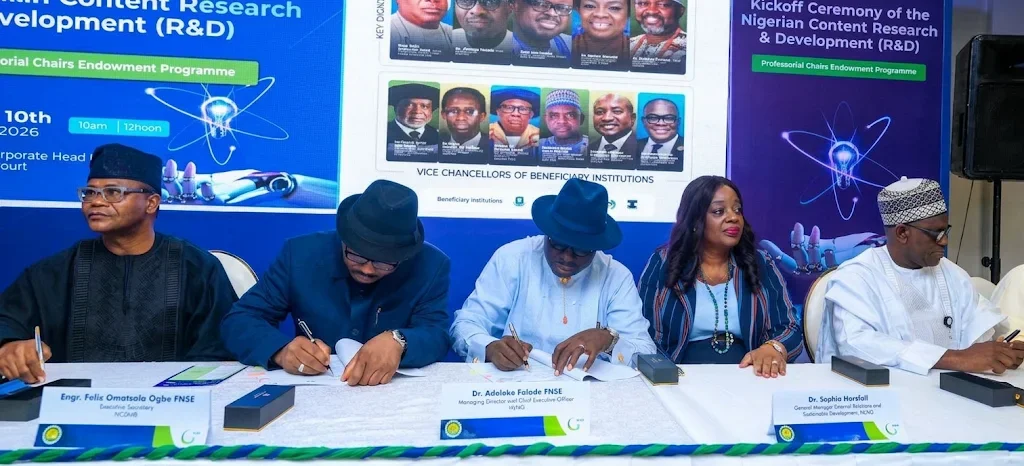
The Nigerian Content Development and Monitoring Board, in partnership with Nigeria LNG Limited, has launched a $9 million professorial chair endowment programme for six Nigerian universities.
Under the arrangement, each beneficiary institution is expected to receive $1.5 million to establish a specialised research chair focused on challenges facing the oil-and-gas industry.
The beneficiary universities are the University of Ibadan, Rivers State University, Modibbo Adama University, Aliko Dangote University of Science and Technology, the University of Nigeria Nsukka, and the University of Abuja, also known as Yakubu Gowon University.
The research areas named for the programme include natural gas processing, pollution control, digital engineering, energy transition, green energy, emissions management and satellite intelligence for resilient gas infrastructure.
According to Premium Times, the endowment framework also includes research targets, commercialisation pathways, knowledge-sharing arrangements, and provision for minor civil works and infrastructure upgrades.
The initiative links academic research directly to technical and operational issues in Nigeria’s oil-and-gas sector. By placing funding in named universities and tying it to defined research themes, the programme is expected to support longer-term work rather than one-off studies.
The announcement also stands out for its spread across institutions in different parts of the country, with each school assigned the same funding level under the endowment.
Why it matters
The key development is not only the $9 million total, but that the funding is being divided evenly across six universities at $1.5 million each. That creates dedicated research capacity in areas that are directly tied to Nigeria’s energy industry, including gas infrastructure, emissions management and cleaner energy pathways.
For universities, the programme goes beyond academic titles by adding commercialisation and knowledge-sharing elements. That means the research is intended to have practical industry use, not just remain on paper.
What it means for your money
There is no immediate direct personal-finance impact for most readers. However, the programme is aimed at strengthening research and skills in energy-related fields, which could matter over time for students, researchers, universities and firms working in Nigeria’s oil-and-gas value chain.
-
The next stage to watch is how each university sets up its research chair and defines project delivery under the endowment. It will also be important to monitor whether the promised research targets, commercialisation pathways and infrastructure support are implemented as outlined.
Readers can also watch for future updates on research output, industry partnerships and whether any of the funded work leads to practical solutions in gas processing, emissions control or energy transition.
The headline fact is simple: six Nigerian universities are set to receive $1.5 million each under a $9 million NLNG-NCDMB research endowment focused on oil-and-gas challenges and energy-related innovation.
Five stories, the key numbers, and why they matter. Free, no ads.
Subscribe free