MONEY - ECONOMY
- What happened: The Nigeria Labour Congress (NLC) has given the Federal Government 14 days, starting October 9, 2026, to reduce petrol prices and begin negotiations for a higher national minimum wage.
- Key detail: The union wants petrol prices returned to their 2024 levels and a review of the current ₦70,000 minimum wage, warning that failure to act could trigger industrial action.
- Why it matters: Lower petrol prices and higher wages could ease financial pressure on millions of Nigerians, but a prolonged dispute could also disrupt businesses and essential services.
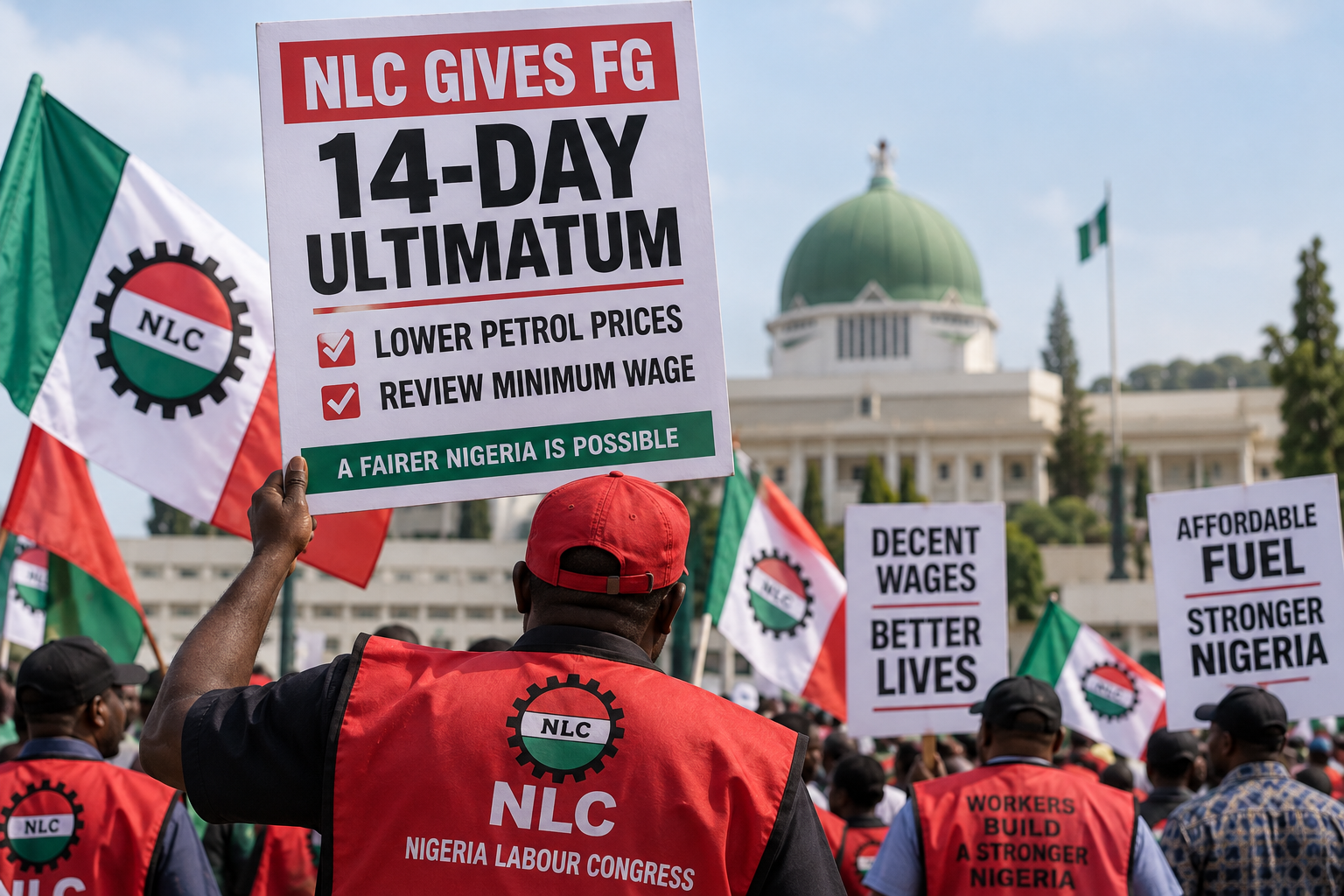
The Nigeria Labour Congress (NLC) has issued a 14-day ultimatum to the Federal Government, demanding lower petrol prices, fresh minimum wage negotiations and immediate measures to ease the rising cost of living.
The ultimatum, which takes effect from Friday, October 9, 2026, follows a joint meeting of the union's National Executive Council (NEC) and Central Working Committee (CWC) in Abuja.
In a communiqué signed by NLC President Joe Ajaero, the labour union called on the government to reduce petrol prices nationwide to the levels recorded when Nigeria's current minimum wage was approved in 2024.
It also demanded that negotiations begin on a new national minimum wage before the end of October.
Nigeria's current minimum wage stands at ₦70,000 per month, following an agreement reached between the government and organised labour in July 2024.
However, the NLC argues that rising prices and the declining purchasing power of the naira have made the existing wage insufficient to cover basic household needs.
Beyond petrol prices and wages, the union is demanding tax relief for workers, immediate wage support payments and implementation of outstanding agreements with public-sector workers, including health-sector unions.
The NLC warned that it could take further action if the government fails to respond within the two-week period.
Although industrial action remains a possibility, the union has not announced a nationwide strike date as part of the ultimatum.
Why it matters
The dispute highlights a growing concern for Nigerian workers: even when salaries remain unchanged, their purchasing power can fall as everyday expenses increase.
Petrol is a particularly important part of that equation.
Higher fuel prices affect transportation costs, food distribution, business operations and the cost of running generators.
When those expenses increase, households often end up paying more for goods and services, even when their incomes have not changed.
For workers earning the national minimum wage, the financial pressure can be particularly significant.
A monthly salary of ₦70,000 must compete with expenses such as transport, food, rent, electricity, education and healthcare.
The NLC believes a combination of lower petrol prices and improved wages is necessary to restore workers' purchasing power.
The government, meanwhile, has introduced temporary measures intended to reduce the impact of higher fuel costs.
On October 9, NNPC confirmed that a petrol discount introduced at its retail stations on October 1 would continue until October 31.
However, the company stressed that the discount does not represent a return to fuel subsidies or establish a uniform nationwide petrol price.
The key question is whether temporary discounts and other government measures will be sufficient to address labour's demands.
What it means for your money
If you earn the minimum wage
A successful negotiation could eventually lead to a higher national minimum wage, potentially increasing the income of eligible workers.
However, the NLC has not secured a new wage agreement, and there is no confirmed increase or implementation date.
If you commute daily
A meaningful reduction in petrol prices could help lower transportation costs, particularly if commercial transport operators pass their fuel savings on to passengers.
But lower pump prices do not automatically guarantee reduced bus or taxi fares.
If you run a small business
Businesses that rely on fuel for transportation, deliveries or generators could benefit from lower petrol prices.
At the same time, any future wage increase could raise payroll expenses for employers with workers affected by the new wage requirements.
If you are managing household expenses
Reduced fuel costs and higher wages could improve household purchasing power, but the actual benefit will depend on how prices change and whether any new wage agreement applies to your employment.
For now, neither a nationwide reduction to 2024 petrol prices nor an increase in the national minimum wage has been agreed.
What to watch next
Five stories, the key numbers, and why they matter. Free, no ads.
Subscribe free